
Blog
How Miscanthus improves soil and water quality
For years, I have heard many old-time farmers say, “water is worth more than its weight in gold.” It might sound a little crazy that water would be so valuable when you think about how many times you wash your hands or do a load of laundry, but to a farmer, going without water means he goes without food. For anyone who is not a farmer, a lack of water will also mean a lack of food. But if gold were edible, I guess that saying wouldn’t be true. Water is the most sacred nutrient known to man because the lack of water is surely death and for hundreds of years, man has been trying to manage this precious resource.
According to the United States Department of Agriculture-Farm Service Agency, the Conservation Reserve Program (CRP) is a program enlisted by the United States Federal Government in 1985 to help tackle the issues of water quality and soil loss through erosion and wind. Interestingly enough, many people knew there was an issue long before the current CRP. It all started back in the early 1930s. Much of the Great Plains, which was known for 6 feet of topsoil, had been plowed under for four generations to grow crops. When drought struck from 1934 to 1937, the soil lacked the stronger root system of grass as an anchor, so the winds easily picked up the loose topsoil and swirled it into dense dust clouds, called “black blizzards.” As time went on, recurrent dust storms killed most cattle and pasture lands while most of the population had left for the Coasts. Later in the 1950s and early 1960s, the Soil Bank Program was started which paid farmers to retire certain worn lands for 10 years.
Today, in exchange for a yearly rental payment, farmers enrolled in CRP agree to remove environmentally sensitive land from agricultural production and plant species that will improve environmental health and quality. Many would say this program has been a success. When looking at some CRP land in Kansas, which had over 2.7 million acres enrolled when the program first started, research found that when compared to similar soils of continuously cropped land, the CRP land had a greater resistance to soil erosion both by wind and water. Another research project done in Illinois showed that the CRP decreased soil erosion between 24 and 37%. The CRP land also improved organic matter content.
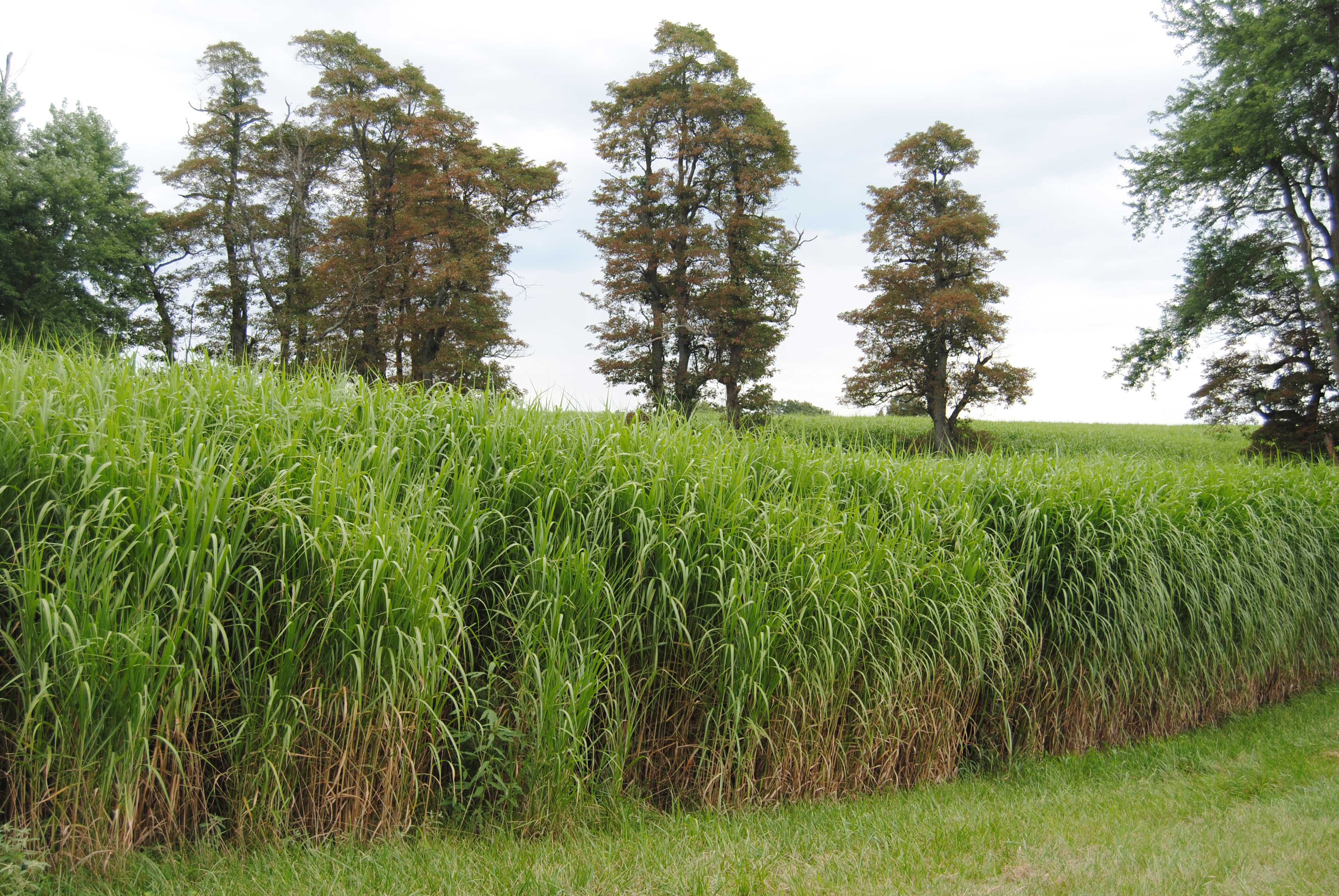
So why bring up the Conservation Reserve Program and all the benefits it has when my primary interest is in Miscanthus? The reason is Miscanthus is like CRP on steroids. Conservation Reserve Program was designed to take land being ruined by crops and put back into grass to help stop erosion. Miscanthus is a perennial grass crop that has a root system that can penetrate up to 12’ deep in the soil. What this means is that the hardpans, claypans and crust layers that make up a large portion of the Midwest lands is now being penetrated by Miscanthus roots which allow for better water infiltration through the soil profile which in turn decreases the amount of runoff. Not only do the grasses hold the soil in place and keep it from eroding into the streams, rivers and lakes but the roots from the grass also helps the soil structure and allows water to move more freely through the soil profile.
About 50 years ago, a wealthy man named David Bamberger purchased over 5,000 acres in Texas Hill Country. He set out to take land that was overgrazed and overgrown with cedar trees, and turn it back into native prairies. Bamberger planted grasses on the hill sides and bulldozed many trees from the land. He had wells drilled, even though there wasn’t any water in the aquifers. After two years, springs started popping up on the land and old, dry ponds began to fill. Plus, the wells had water. The grasses that were planted helped water move through the soils rather than just running off the surface. The land in Texas that once was barren with very little water was now lush land with original habitats and running waters. David Bamberger has helped set an example in stewardship of land and helped shine light on how land management directly affects water conservation.
Many farmers that grow Miscanthus for Renew Biomass would echo what Mr. Bamberger has done. Many farms that were once cropped with corn and soybean had ponds built to catch water from runoff. These same fields that now have Miscanthus, have ponds that are dry or have very little water. It is not because Miscanthus uses more water, because in fact it uses the same amount as corn, it is because Miscanthus being a perennial grass provides the roots structure and allows water to better penetrate the soil profiles which decreases the amount of runoff.
Sources
1. https://www.fsa.usda.gov/programs-and-services/conservation-programs/index
2. How the Dust Bowl Environmental Disaster Impacted the U.S. Economy by Kimberly Amadeo
3. https://en.wikipedia.org/wiki/Soil_Bank_Program
4. X.Huang, E.L. Skidmore, and G.L.Tibke (2002) Soil quality of two Kansas soils as influenced by the Conservation Reserve Program
5. Davie and Lant (1994) The effect of CRP enrollment on sediment loads in two southern Illinois streams.
6. http://video.nationalgeographic.com/video/short-film-showcase/50-years-ago-this-was-a-wasteland-he-changed-everything

Eric Allphin, V.P. Business Development
Eric Allphin is a native to Southwest Missouri. He was born in Joplin, Missouri and grew up near Granby, Missouri on a small hobby beef farm. After graduating high school at East Newton, Eric served a two-year mission in Costa Rica for his church. Upon returning home, he received his Associates Degree at Crowder College and transferred to University of Missouri where he graduated in December 2009 with his Bachelor of Science in animal science. After completion of his bachelor’s, Eric decided to further expand his knowledge into agriculture as he felt both degrees would complement each other. Eric received and assistantship with the University of Missouri and worked closely with USDA-ARS. His research was focused around how crop performance changed depending upon the landscape in which that crop was planted. So how corn, soybeans and also perennial grasses like switchgrass or Miscanthus would perform on different topsoil depths. His research was very conclusive, and Eric graduated with his Master of Science in crop, soil and pest management in December 2011.
After owning an ag consulting business for a few years, Eric accepted the position of Director of Agriculture/Agronomist for Renew Biomass. Eric focuses his efforts toward the agricultural side of our business; managing the production of Miscanthus on over 5,000 acres.
Most importantly, Eric has been married to his beautiful wife, Rachel, for 10 years. They have 3 children: Maveric, Wyatt and Emery.