
Blog
Spring Miscanthus Planting Has Come to an End in Missouri
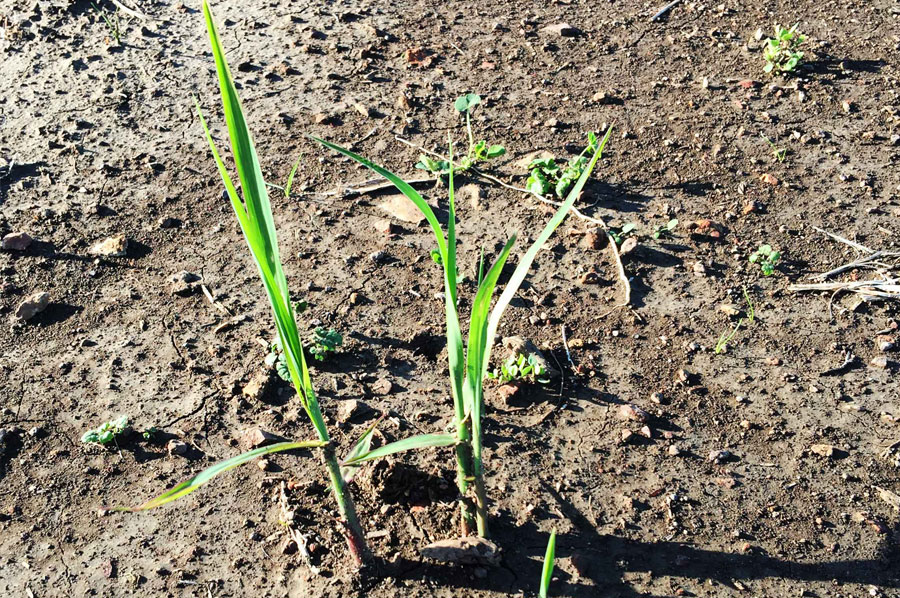
Renew Biomass recently completed our 2016 planting season. We have accomplished the difficult task of planting 1,000 acres of Miscanthus in both the Southwest Missouri area and Mid-Missouri area. As many know, planting Miscanthus is no easy feat. Many of the same issues farmers face when trying to plant a typical row crop exist with Miscanthus. Weed issues, wet soils, cold soils and a finely tilled seed bed are just a few planting hurdles to get over. While every row crop farmer finds a way to combat any of these issues, it is the method of planting Miscanthus that makes it quite difficult and unique.
Miscanthus is planted from rhizomes (underground root material) that comes in all different shapes and sizes. From a three-inch piece about the size of your finger to a cluster of multiple pieces the size of your hand, it takes very specific equipment to regulate flow of material and to plant at a consistent rate in the field. Because of the odd shapes of the rhizomes, the planters are not able to plant based upon the number of rhizomes and count each one that falls, like when planting corn or soybeans. As you know, last year we partnered with New Energy Farms to obtain the highest quality rhizome seedstock.
When New Energy Farms digs rhizomes to ship to us, they sample each bag of rhizomes and determine how many rhizomes in that bag it will take to make 1 pound. From those numbers were are able to adjust our planting rates to obtain a uniformed consistency. Miscanthus is planted by weight per acre, so for example if we have rhizome material that is 18 rhizomes per 1 pound, we would plant about 555 pounds per acre to obtain a 10,000 rhizome per acre population.
Because we are planting rhizomes that are living material, the seedstock has to stay in refrigerated trucks at about 39 degrees Fahrenheit to keep it in dormancy until we are ready to plant. This becomes a logistical nightmare to keep enough full trucks of rhizomes for the planting crew and make sure we don’t have more than we can plant because they won’t last until next year.
As stated in earlier articles, we make every effort to plant right the first year because the next 20 years of harvest depend on it.

Eric Allphin, V.P. Business Development
Eric Allphin is a native to Southwest Missouri. He was born in Joplin, Missouri and grew up near Granby, Missouri on a small hobby beef farm. After graduating high school at East Newton, Eric served a two-year mission in Costa Rica for his church. Upon returning home, he received his Associates Degree at Crowder College and transferred to University of Missouri where he graduated in December 2009 with his Bachelor of Science in animal science. After completion of his bachelor’s, Eric decided to further expand his knowledge into agriculture as he felt both degrees would complement each other. Eric received and assistantship with the University of Missouri and worked closely with USDA-ARS. His research was focused around how crop performance changed depending upon the landscape in which that crop was planted. So how corn, soybeans and also perennial grasses like switchgrass or Miscanthus would perform on different topsoil depths. His research was very conclusive, and Eric graduated with his Master of Science in crop, soil and pest management in December 2011.
After owning an ag consulting business for a few years, Eric accepted the position of Director of Agriculture/Agronomist for Renew Biomass. Eric focuses his efforts toward the agricultural side of our business; managing the production of Miscanthus on over 5,000 acres.
Most importantly, Eric has been married to his beautiful wife, Rachel, for 10 years. They have 3 children: Maveric, Wyatt and Emery.